
Manufacturing Technology
Electronics
Design, test equipment, SMT production, and final assembly of electronics for automotive lighting.
Overview
Our Electronics Unit designs, develops, prototypes, manufactures, and tests the electronic products used in automotive lighting systems. Product engineering, test and control equipment development, electronic board manufacturing, and final assembly sit in one integrated chain.
The unit is organised in two areas: Electronics Engineering and Development, and Electronic Product Manufacturing and Assembly. A project can start from requirements or an RFQ and move through hardware and software design, PCB design, prototyping, engineering analysis, and the development of dedicated test equipment. Once the design is approved, the product moves on to manufacturing, testing, final inspection, and manufacturing engineering support.
Because product design, equipment design, manufacturing processes, and product testing are directly connected, engineering issues can be evaluated and resolved faster, and with more continuity, at every stage of development and production.
Key Features
- 01Hardware, PCB, and firmware design
- 02Thermal, preliminary EMC, and optical evaluation
- 03In-house ICT and FCT test equipment
- 04Automated SMT line, SMD down to 0402
- 05More than 70,000 placements per day
- 06Final assembly with FCT and wire set testing
- 07Traceability and ESD-controlled production
- 08Processes aligned with IATF 16949
01 / 08
Electronics Engineering and Development
The Electronics Engineering and Development team designs, develops, prototypes, analyses, and supports the electronic products and equipment used in automotive lighting systems.
Its capabilities cover circuit and PCB design, firmware and embedded systems development, engineering analysis, prototyping, and the design of dedicated test and control equipment.
A project starts once the requirements or RFQ arrive, with a review of the functional specification, operating conditions, and technical requirements. The team then defines the circuit architecture and technical solution for the application, followed by hardware, PCB, and, where needed, embedded software development.
When the design is complete, prototypes are built, evaluated, and tested through the development stages. Test and analysis results feed design changes and product improvements before the product enters production.
1.1
Hardware and PCB Design
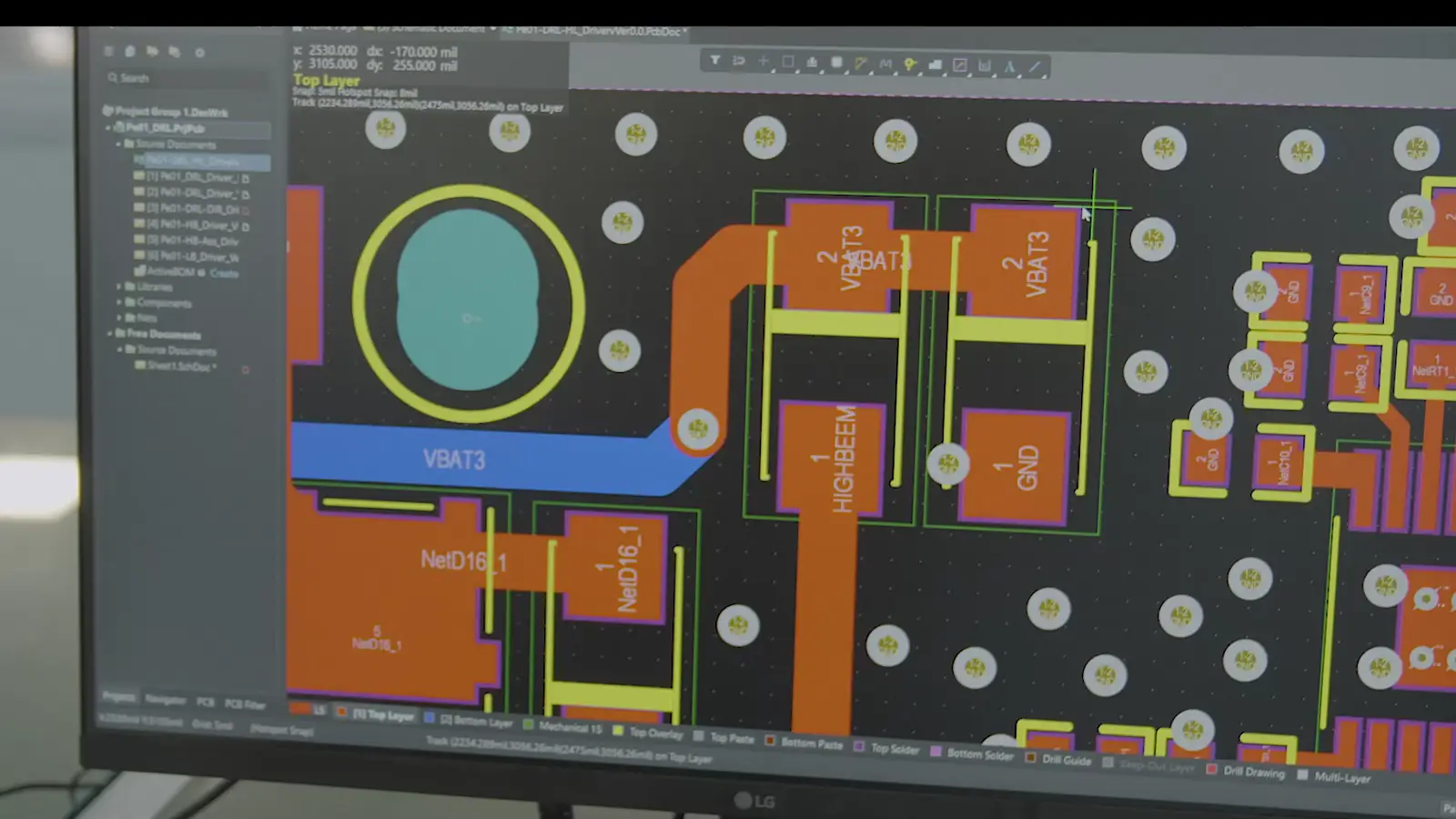
The team designs and develops the electronic circuits used in automotive lighting modules: LED driver and control circuits, other control circuits, component selection and evaluation, PCB design, and prototypes for engineering evaluation.
Designs take into account the automotive environment, functional requirements, electrical and environmental conditions, and the requirements of each project.
- Capabilities
- Circuit design for lighting modulesLED driver and control circuitsPCB designHardware for control systemsComponent selection and evaluationPrototypingDesign changes from test resultsTransfer-to-production support
1.2
Firmware and Embedded Systems
Alongside hardware design, the team develops and programs the embedded software that runs in products and control equipment.
Some control projects use microcontrollers from the PIC and STM families. Hardware and software architectures are developed around the product's functional requirements, operating conditions, and application.
Developing hardware and software together keeps the circuitry, control logic, software behaviour, and test requirements in step.
1.3
Engineering Analysis and Evaluation
During development, engineering analyses and evaluations are carried out at the right stages before final prototyping or production, depending on the project.
They are used to identify design risks, study circuit behaviour, and make an early assessment of product performance. Depending on the project, they can include thermal, EMC, optical, electrical, and design durability assessments, defined and carried out to each project's requirements.
- Thermal
- PCB and component thermal analysisComponent and circuit thermal behaviour
- EMC and electrical
- Preliminary design-level EMC analysis in CSTEMC review of the designBehaviour under project-specified electrical pulses2a, 2b, and 5b pulse testing
- Optical and durability
- Optical evaluation based on product architecturePerformance and design durability evaluation
02 / 08
Test and Control Equipment Design and Manufacturing
One of the unit's specialist capabilities is designing and building dedicated test and control equipment for each product and manufacturing process.
Production test equipment, including ICT and FCT, is developed by the engineering team from the PCB layout, test points, required parameters, and defined test sequences. Pin-spring fixtures make the electrical contact with the PCB test points for each test.
Equipping production with test equipment made for each product links the product's design directly to the way its manufacture is controlled. Besides checking electrical parameters, these systems can be built for functional testing and, where needed, optical measurements.
2.1
Electrical and Optical Test Systems
Electrical, functional, and optical testing is an important part of controlling the electronic products used in automotive lighting. Depending on each product's specification, the equipment the unit develops can carry out the tests below.
Optical test systems use precision sensors to measure optical parameters and, depending on the product, can evaluate light over the required angular range, up to 120 degrees.
- Electrical
- Electrical function verificationCurrent measurementModule function testing
- Optical
- Light intensityLight colourLight distribution, up to 120°
2.2
Panel-Level ICT
Some products are made as several modules on one panelised PCB. For these, ICT is carried out before the modules are separated, so defined electrical parameters are verified before the boards move on.
Once the panel has passed its checks, it is depanelised and the individual modules are prepared for final assembly. After depanelisation, FCT is carried out at final assembly to check each module's function once assembly and electrical connections are complete.
Panelised products
- 01SMT assembly
- 02Panel-level ICT
- 03Depanelisation
- 04Final assembly
- 05FCT
03 / 08
Electronic Board Manufacturing
- SMT line
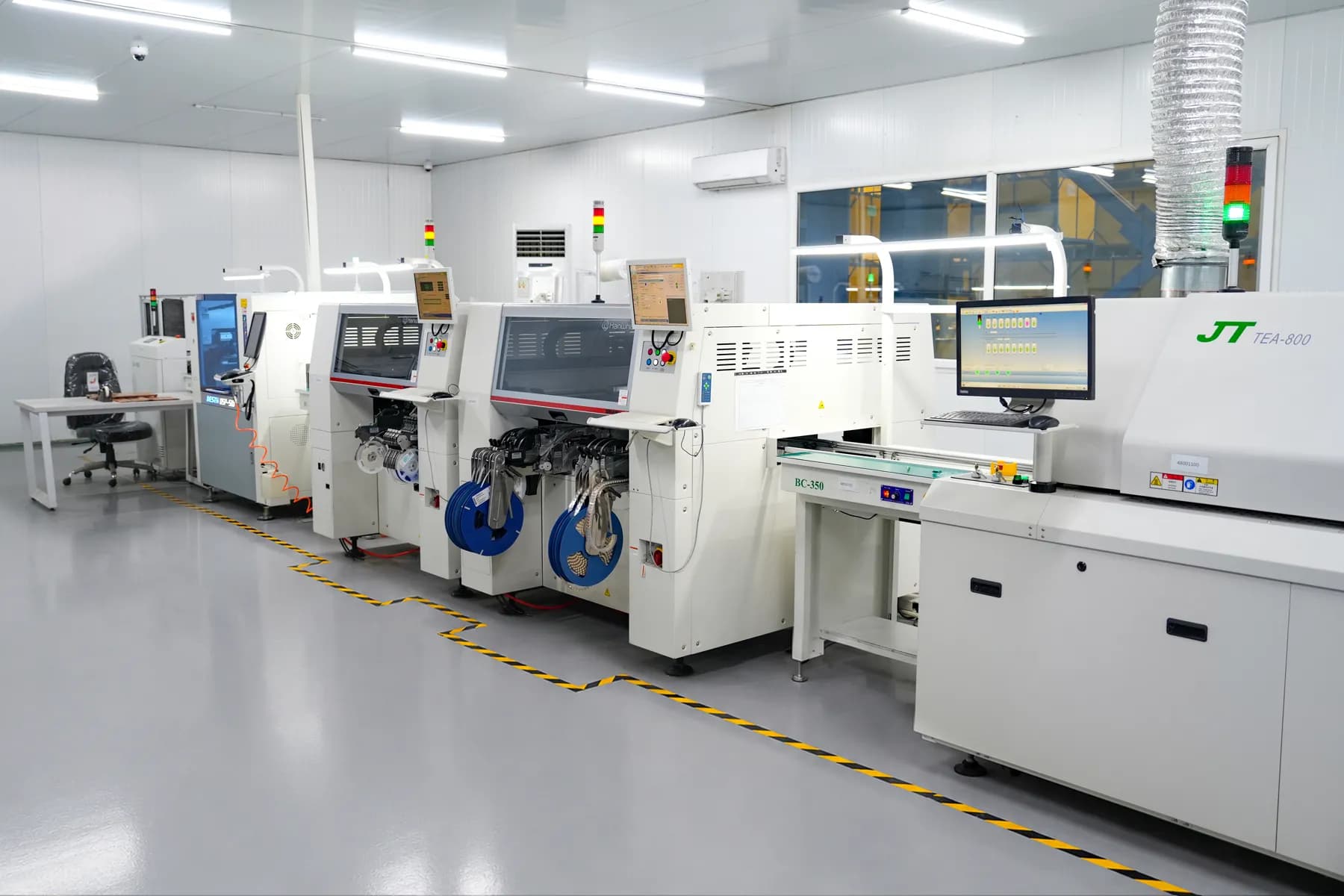
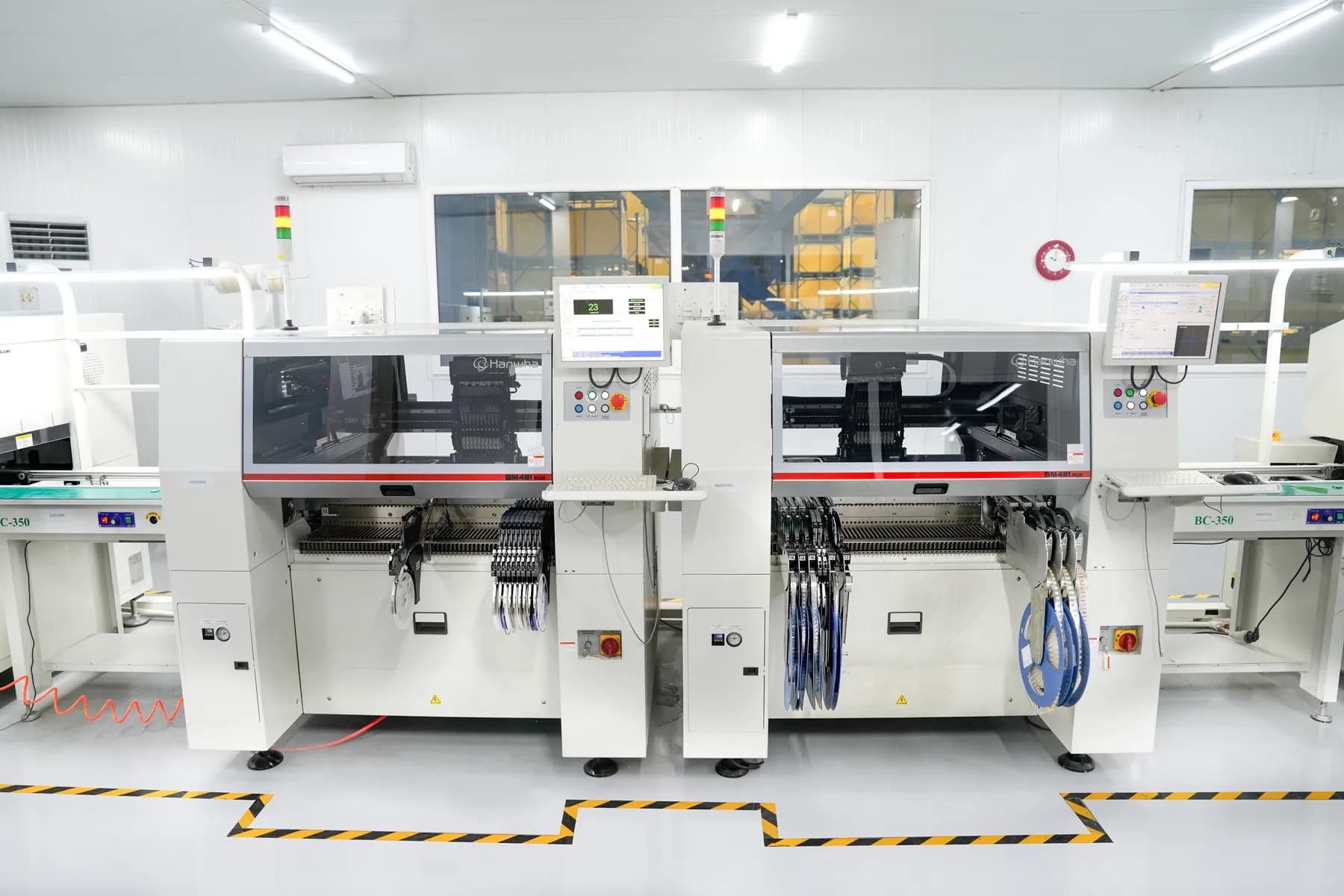
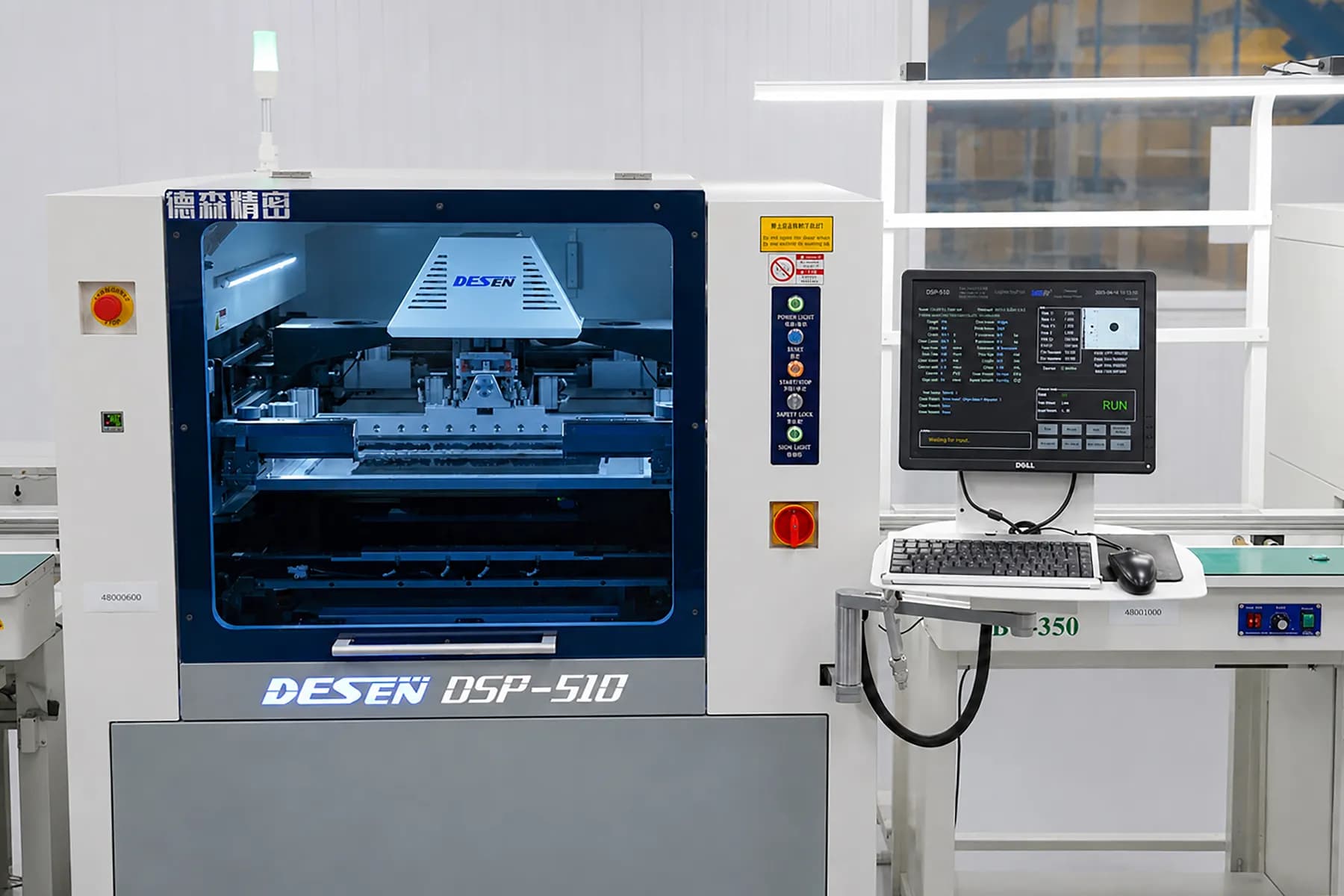
- Solder paste printerTwo pick-and-place machines8-zone reflow ovenAOIICTAutomatic PCB depanelisation
- Substrates and parts
- FR-4FPCBSMD down to 0402No THD components
The electronics manufacturing unit runs an automated SMT line for the electronic boards used in automotive lighting systems.
The line assembles SMD components on FR-4 and flexible (FPCB) substrates. The products made on it use no through-hole (THD) components, and the process handles SMD parts down to the 0402 footprint.
3.1
Production Capacity and Reflow
Line capacity depends on the number of components and the placement volume each product needs. The stated capacity is more than 70,000 placements per day; actual output per product depends on component count, PCB density and complexity, cycle time, the production schedule, and operating conditions. This lets the line build boards with different component densities and levels of complexity.
Soldering is done in an 8-zone reflow oven. The thermal profile is set for the PCB type, solder paste, component types, and process conditions, and is controlled and adjusted to minimise assembly defects and keep solder joint quality stable.
3.2
Quality Control in the SMT Process
Quality control is not left to final inspection; it happens at several points in the process. AOI inspects the assembly visually and detects placement and assembly defects. ICT verifies electrical parameters and runs defined tests at board or panel level.
Together, these checks catch some process defects early and stop non-conforming products from moving on to later stages.
3.3
Automatic PCB Depanelisation
When panel-level assembly and testing are complete, the boards are separated by automatic PCB depanelisation. Automating this step reduces manual handling, makes separation more repeatable, and prepares modules more consistently for final assembly.
04 / 08
Electronic Module Final Assembly
- Depending on the product
- Final module assemblyFunctional test (FCT)Wire set testFunction verificationHot rivetingHousing marking and identificationFinal inspection
After SMT, panel-level testing, and separation, the products enter final assembly, where the final assembly operations, functional tests, and final product checks are carried out.
FCT at this stage checks the final function of each module once assembly and electrical connections are complete.
05 / 08
Traceability and ESD Control
Traceability and ESD control are built into how the unit controls its manufacturing processes.
5.1
Traceability
Operators on the line have unique identification and barcodes, and each product is identified through the manufacturing stages to record its process status, inspection results, and completed tests. This links the product, the process, the operator, and the defined test and inspection results.
Recording that a product has passed its specified inspections and tests is part of verifying its status before it moves to the next stage.
5.2
ESD Control
Electronic components and circuits are sensitive to electrostatic discharge (ESD), so ESD conditions are controlled across the whole electronics manufacturing and assembly area. The aim is to control the risk of discharge and reduce the chance of damage to components and modules during manufacture and assembly.
- ESD infrastructure
- Antistatic equipment and glovesGrounding systems and pointsGrounded flooringControlled assembly environmentHandling rules for ESD-sensitive parts
06 / 08
Manufacturing Engineering and Technical Support
- Activities
- Production line supportEquipment troubleshootingEquipment modification and improvementFixture development and modificationNew equipment commissioningPreventive maintenance (PM)Process issue investigation and correction
A defining feature of the unit is the direct link between the engineering team and manufacturing. Production control equipment and fixtures are developed by the engineering team for each process and, once commissioned, are supported by the same team.
Preventive maintenance of the unit's equipment is carried out by the manufacturing engineering group together with members of the electronics engineering team. Working this closely means faster response to equipment and process issues, and manufacturing feedback reaches the engineers directly.
6.1
Technical Training and Knowledge Transfer
Training is part of the engineering unit's work. Based on process needs, staff and related departments are trained in electronics fundamentals, ESD requirements, manufacturing principles, and the technical requirements of electronic assembly and production.
The aim is a shared understanding of technical and process requirements, and people who carry out electronic manufacturing and assembly correctly.
07 / 08
Test and Reliability Infrastructure
Developing test, durability, and reliability infrastructure is one of the unit's development directions. Within engineering, durability, performance, and behaviour tests under the electrical conditions each project requires are carried out or supported.
An ageing chamber is being set up to expand testing of the stability, durability, and operating conditions of electronic products, which will widen the scope of durability and stability evaluation.
08 / 08
Integration of Engineering, Manufacturing, and Testing
The unit is built on direct integration between product design, test equipment design and manufacturing, production, and product control.
A new project can start with an RFQ and technical requirements. After the requirements review, hardware and PCB design and, where needed, firmware or software development are carried out. The prototype is built and goes through engineering analysis and testing, while the dedicated control and test equipment is developed alongside it. After design approval and process preparation, the product enters SMT production and the assembly stages that follow.
Electrical checks, AOI, ICT, functional tests and, where required, optical tests are carried out at different points in the process, and FCT and final inspection complete final assembly. Throughout, production and test data are used to control product status and traceability, and the engineering team supports, maintains, modifies, and improves the manufacturing equipment and processes.
This way the product, its manufacturing process, and its test method are never developed in isolation, and product engineering stays connected to manufacturing from the first stages of a project through ongoing production.
Project path
- 01RFQ and requirements
- 02Hardware, PCB, and firmware design
- 03Prototype and engineering analysis
- 04Test equipment development
- 05SMT production
- 06AOI and ICT
- 07Final assembly and FCT
- 08Final inspection
8.1
Engineering Standards and Requirements
The unit works to the technical and process requirements of the automotive industry and of electronic product manufacturing and testing. At system and process level, the requirements of IATF 16949 are taken into account. For the design, assembly, and control of electronic products, the relevant IPC and IEC standards are applied according to the subject and needs of each project.
Product design and development also consider vehicle operating conditions, project requirements, electrical and environmental specifications, component selection, PCB design, test methods, and the requirements for transfer to production.
In Summary
The Electronics Unit combines engineering design and development with industrial manufacturing and control, and the direct link between the two is central to how it is organised. Its focus is electronic modules for automotive lighting, where circuit design, component selection, PCB manufacturing, production conditions, test methods, and automotive requirements have to be handled as one coherent engineering chain.
Business Inquiry
Discuss this manufacturing capability
Contact Modern Group to talk through process requirements, capacity, or tooling.